
Using a VOC Gas Monitor for Accelerant Detection
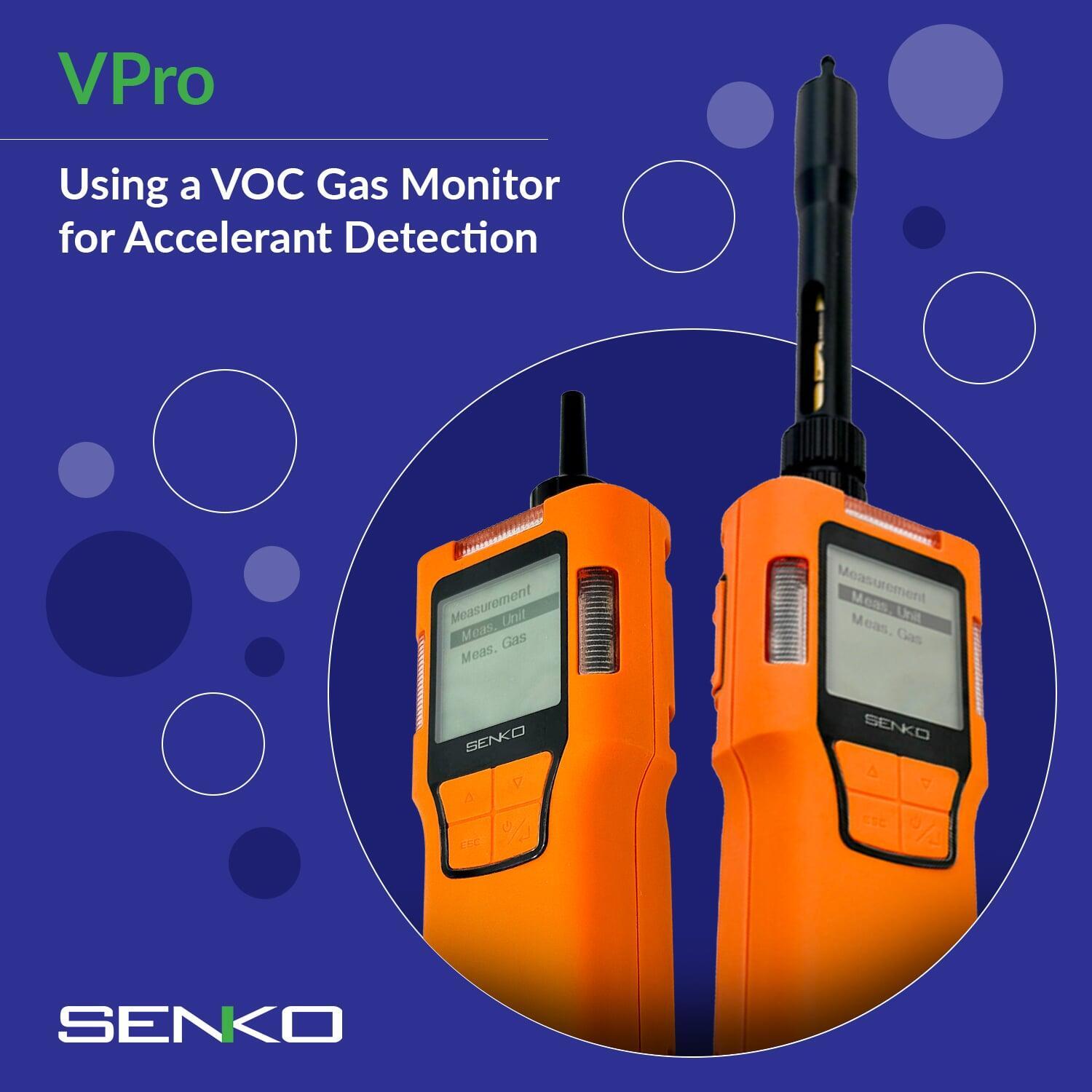
In industrial environments where flammable substances are stored, processed, or removed, the ability to detect accelerants is a fundamental safety requirement. Accelerants, most commonly petroleum-derived hydrocarbons, can persist as vapours or residues long after a spill, leak, or fire event. If left undetected, these compounds pose a serious ignition risk, particularly before welding, cutting, or grinding operations begin.
A Volatile Organic Compound (VOC) gas monitor provides the resolution and sensitivity required to identify these hazards at very low concentrations. For technical teams, VOC monitoring is not about identifying a single chemical in isolation. It is about understanding complex hydrocarbon mixtures, their behaviour in real environments, and the conditions under which they become dangerous.
Why accelerant detection matters in industrial safety
Accelerants are used deliberately in some industrial processes, but more often they appear unintentionally, as residues from fuels, solvents, lubricants, or contaminated wash-down fluids. Their volatility allows them to evaporate quickly, creating flammable atmospheres that may not be visible or easily smelled.
This risk becomes especially acute in confined or semi-confined spaces. When hot work is introduced, even trace levels of hydrocarbon vapour can ignite. The resulting pressure rise inside vessels, tanks, or enclosed machinery can exceed structural design limits, leading to rupture or explosion. VOC gas monitoring provides early, quantitative insight into whether these risks are present before work begins.
Detecting residual hydrocarbons after spills or cleaning
Accelerants are rarely single substances. They are typically complex mixtures of petroleum hydrocarbons spanning a range of molecular weights. After a spill or fire incident, heavier fractions may remain absorbed into concrete, insulation, gaskets, or coatings, slowly releasing vapours over time.
A VOC monitor is particularly effective at detecting these residual hydrocarbons because it measures total volatile organic compounds rather than relying on one specific target gas. This makes it well suited for:
Verifying that cleanup operations have removed flammable residues
Checking vessels and piping before maintenance or repair
Assessing whether porous surfaces continue to off-gas hydrocarbons
In practice, this allows safety teams to move beyond visual inspection and use quantitative data to support go or no-go decisions.
Calibration strategy: why higher hydrocarbons matter
One of the most important technical considerations in accelerant detection is calibration. The choice of calibration gas directly influences how a VOC monitor responds to real-world hydrocarbons.
Sensitivity gaps with methane-only calibration
Monitors calibrated solely with methane can significantly under-report heavier hydrocarbons. Methane is a small, simple molecule that behaves very differently from petrol, diesel, or solvent vapours. As a result, readings may appear deceptively low even when flammable accelerants are present.
The pentane or propane standard
When the specific hydrocarbon is unknown, as is often the case near leaking storage tanks or during post-incident investigations, best practice is to calibrate using a higher hydrocarbon such as pentane or propane. These gases better represent the molecular weight and ionisation behaviour of typical accelerants.
By calibrating this way, catalytic bead or photoionization sensors respond more accurately to complex petroleum mixtures. The result is a conservative, safety-focused measurement that reduces the risk of false reassurance.
Using indicator compounds to assess risk
Because accelerants are mixtures, detection often relies on indicator compounds rather than full chemical identification. Certain hydrocarbons are used as markers to infer the presence and severity of contamination.
Benzene as a high-risk indicator
Benzene is a well-known component of many petroleum products and is classified as a high-risk compound due to its toxicity. Its presence at even low concentrations can indicate broader hydrocarbon contamination.
VOC monitors capable of resolving or flagging benzene-equivalent responses help technical teams quantify both fire risk and potential health exposure. This is particularly important when determining whether residual contamination meets thresholds for significant environmental or occupational harm.
Fraction-based assessment
Advanced VOC monitoring can also support fraction analysis, helping teams understand whether detected hydrocarbons fall into lighter, more volatile ranges or heavier, persistent fractions. This distinction informs decisions about ventilation duration, further cleaning, or material removal.
Managing cross-interference in complex environments
Industrial sites rarely contain a single chemical hazard. VOC monitoring often takes place alongside welding gases, process chemicals, or by-products of combustion.
Understanding cross-sensitivity
Some sensors exhibit cross-sensitivity, where non-target gases influence readings. For example, hydrogen or acetylene can increase responses on certain detectors, potentially obscuring the true source of VOCs. Without awareness of this effect, readings may be misinterpreted.
The value of high-precision sensors
High-quality sensor design reduces uncertainty in these situations. Precision-built sensors, such as those used in SENKO portable devices, provide more stable and repeatable responses in mixed-gas environments. While no field instrument can fully eliminate interference, reliable qualitative trends allow experienced operators to distinguish genuine accelerant signals from background noise.
Field Deployment: The “Sweep” Technique for Trace Detection
Accelerant detection in industrial or post-incident environments often feels like looking for a needle in a haystack. While standard safety sensors (LEL) are designed to tell you if a room is about to explode, they are often "blind" to the trace residues that precede a disaster.
The Detection Gap: PID vs. LEL
To understand why the SENKO V-Pro is the tool of choice for this task, you have to look at the "Detection Gap." A standard LEL sensor usually has a resolution of 1% LEL, which for gasoline is roughly 110 ppm (parts per million).
However, the human nose can often smell gasoline at 0.5 ppm, and a high-quality PID can detect it at 0.1 ppm. If you rely solely on an LEL monitor, you could be standing over a significant hidden leak or a soaked floorboard, and the device will read "0" while your nose, and the PID, knows better.
Using the “V-Pro Sweep”
Because the V-Pro provides near-instantaneous readings and rapid recovery (clearing the sensor quickly after exposure), it can be used for "active searching" rather than just static monitoring.
Surface Proximity: Move the probe inlet slowly, approximately 1–2 inches per second, about an inch away from cracks in flooring, wall joints, or debris piles.
Identifying Seepage: In many cases, accelerants seep into porous materials like concrete or timber. While the ambient air in the room may be clean, the PID will "spike" the moment the probe passes over a point of seepage.
Locating the Point of Origin: By mapping these spikes, technical teams can pinpoint exactly where a spill originated or where cleaning efforts have failed to reach deep-seated residues.
Overcoming "Olfactory Fatigue"
It is a common industrial myth that "if there’s a leak, we’ll smell it." In reality, humans suffer from olfactory fatigue, our brains stop registering a smell after just a few minutes of exposure. Furthermore, in post-fire or heavily industrial areas, the "smell" of an accelerant is often masked by burnt plastics or heavy grease.
A PID doesn't get tired and isn't fooled by competing odors. It provides a quantitative digital fingerprint of the atmosphere, ensuring that "hidden" hazards stay visible.
Data Logging for Forensic Recovery
The SENKO V-Pro’s ability to log data is critical here. By recording the "spikes" during a sweep, you can generate a digital heat map of the contamination. This is invaluable for:
Arson or Incident Investigation: Proving the presence of ignitable liquids under debris.
Validation of Cleaning: Providing a "clean" data log to prove that VOC levels have dropped below safe thresholds before hot work begins.
Final thoughts
Accelerants do not need to be present in large quantities to pose serious danger. Trace vapours trapped in confined spaces or absorbed into materials can be enough to trigger catastrophic events when ignition sources are introduced.
VOC gas monitors give industrial teams the visibility needed to detect these risks early. By combining appropriate calibration strategies with advanced sensor technology, operators can move from assumption to evidence-based decision-making, protecting both personnel and infrastructure before work begins.